
Hear from Our Customers
There’s a version of your Blue Point home where you’re not second-guessing the air your family breathes, not dreading what’s behind the drywall, and not watching the same dark spot creep back six months after someone “took care of it.” That’s what real mold remediation gets you — not a painted-over problem, but an actual resolution.
For Blue Point homeowners, the moisture challenge is built into the geography. The Great South Bay drives humidity into crawl spaces and basements year-round. Homes built in the 1940s and 1950s — which make up the majority of the housing stock in the 11715 ZIP code — weren’t built with vapor barriers or modern ventilation standards. That combination creates conditions where mold doesn’t just appear after a flood. It grows quietly, in places you’re not looking, for months before anyone notices.
When we complete remediation correctly, you get more than a clean space. You get documentation — a post-remediation air quality clearance report that matters if you’re dealing with an insurance claim, selling your home, or simply want proof the job held. In a community where homes are selling in the $600,000–$700,000 range, that written record isn’t a formality. It’s protection.
Richard Peterson, the owner of First Response Restoration and Cleaning Inc., holds personal New York State licenses in both mold assessment and mold remediation. That’s not a company registration filed somewhere — it’s his name on the license, verifiable through the NYS Department of Labor. Under Article 32 of New York State Labor Law, those credentials are legally required to perform this work. Not every company operating in Blue Point can say that.
We’ve been serving Suffolk County communities for over 30 years, including the South Shore neighborhoods along the bay — the same areas that took the hardest hit from Hurricane Sandy and have been dealing with the long-tail moisture and mold consequences ever since. Our team is IICRC-certified across the board, meaning every technician who enters your Blue Point home has been formally trained to the S520 Standard for Professional Mold Remediation — not just the person who gave you the estimate.
We’re also one of the few restoration companies in the area with an integrated cleaning division, which means the job doesn’t stop when the structural work does. You’re not left coordinating a second crew before your home is livable again.
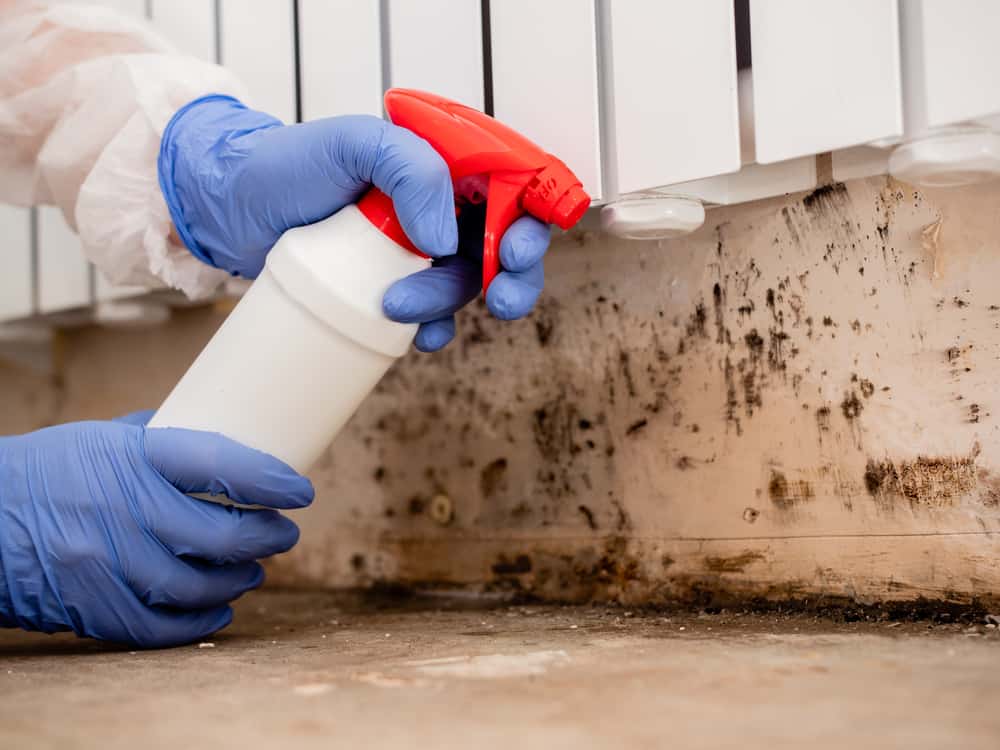
We start by finding where the moisture is coming from, because that’s the only way to stop mold from coming back. In Blue Point, that often means looking at more than one source — a slow foundation seep, a crawl space without proper vapor control, an attic with inadequate ridge ventilation, or condensation building up on HVAC components in humid summer months. Skipping this step is why mold returns. We map moisture before anything else.
Once the source is identified, we set up containment to isolate the affected area and prevent spores from spreading to other parts of your home during the removal process. Contaminated materials are removed, affected surfaces are treated with EPA-registered antimicrobials, and the area is dried and stabilized. If structural repairs are needed — and in older Blue Point homes, that sometimes means replacing sections of subfloor, sheathing, or framing — we handle that as part of the scope, not hand it off to someone else.
After the work is complete, independent air quality testing confirms the results. You receive a written clearance report. In cases where the damage is connected to a storm event, a burst pipe, or another insurable cause, the documentation from this process is exactly what your insurance carrier needs. We help you understand what your policy covers and how to document the claim — something most remediation companies in the area don’t do.
Ready to get started?
Mold remediation in Blue Point covers more ground than most homeowners expect going in. Because of the age of the housing stock and the bay-adjacent environment, the most common problem areas are crawl spaces, attics, and basements — and each one presents differently.
Crawl space mold remediation in Blue Point typically involves post-war ranch-style homes where unencapsulated dirt floors have been accumulating moisture from the shallow water table for decades. Attic mold remediation in Blue Point often shows up in Cape Cod-style homes where inadequate soffit and ridge ventilation has allowed summer humidity to colonize roof sheathing and rafters — sometimes invisibly, until a home inspection catches it. Basement mold remediation in Blue Point ranges from surface-level growth after a single flood event to deeper structural involvement in homes that have taken on water repeatedly over the years, including during Sandy.
Black mold remediation follows enhanced containment protocols because Stachybotrys and similar species require stricter handling to prevent cross-contamination during removal. We offer emergency mold remediation around the clock — because when a nor’easter pushes water into a bay-area basement at 11 p.m. on a Saturday, the 24–48 hour window before active mold growth starts doesn’t care what day it is. We’re operational 24/7, not just reachable by voicemail.
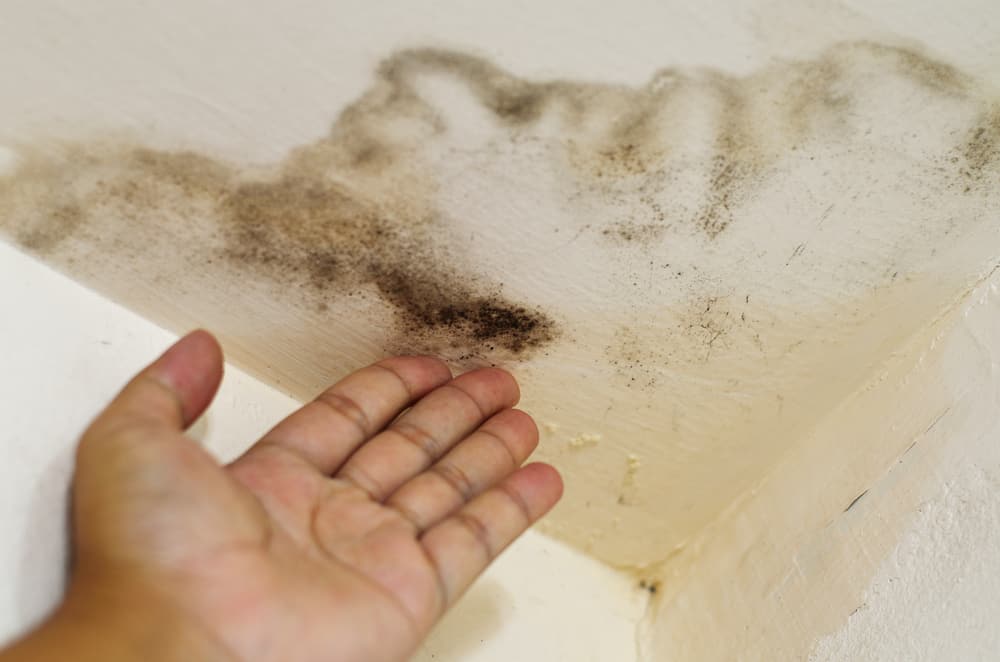
The honest answer is that it depends on where the mold is, how far it’s spread, and what’s behind it. For most residential projects in Blue Point, you’re looking at a range of roughly $1,200 to $3,800 for standard remediation. Attic or crawl space jobs — which are extremely common in the 1940s and 1950s-era homes that make up most of the 11715 ZIP code — can run from $1,500 to $9,000 depending on the extent of contamination and whether structural materials need to be replaced. Black mold remediation sits at the higher end of those ranges because of the additional containment protocols involved.
What drives cost up most often isn’t the mold itself — it’s the moisture source that’s been feeding it. A crawl space that’s been accumulating bay humidity for years without proper vapor control is a different scope than a single-room surface mold issue. Any estimate that doesn’t include moisture source identification before quoting you a number should raise a flag.
It depends on the cause, and that distinction matters more than most people realize. Most standard homeowner’s insurance policies in New York cover mold remediation when it results from a sudden, covered event — a burst pipe, a roof failure after a storm, or documented flooding from a named storm. What they typically don’t cover is mold that developed gradually due to long-term moisture issues, deferred maintenance, or a slow leak that went unaddressed.
For Blue Point homeowners, this line gets complicated quickly. If your mold problem is connected to storm surge from the Great South Bay or a weather event that’s on record, you likely have a stronger claim than someone whose crawl space has been damp for years without a clear triggering event. We help you document the damage in the format your carrier needs and walk through what your policy actually covers — because the difference between a covered claim and a denied one often comes down to how the damage is described and supported, not just what happened.
“Mold removal” isn’t really a thing — at least not a complete thing. Mold spores exist in virtually every indoor environment. The goal of remediation isn’t to eliminate every spore, which is impossible. It’s to bring mold levels back to a normal, safe baseline and eliminate the active growth that’s causing a problem. Removal implies you can scrub a surface and be done. Remediation means containing the area, removing contaminated materials properly, treating affected surfaces, addressing the moisture source, and verifying the results with air quality testing.
The distinction matters practically because a company that offers “mold removal” and hands you a bottle of bleach solution is not doing the same job as a licensed remediation contractor following the IICRC S520 standard. In New York State, mold remediation is regulated under Article 32 — contractors performing this work are legally required to hold a state-issued license. If someone is offering you mold removal without a license number, that’s not just a quality concern. It’s a legal one.
This is one of the most time-sensitive situations in real estate, and it happens regularly in Blue Point given the age of the housing stock and the bay-adjacent moisture environment. When mold shows up during a home inspection, you’re usually working against a contract deadline — which means you need a licensed remediation contractor who can assess the scope quickly, provide a written estimate, complete the work, and produce a clearance report before closing.
The clearance report is what buyers, sellers, and attorneys actually need to move forward. It’s not enough to say the mold was “taken care of” — you need documented air quality results from post-remediation testing to confirm it. We’ve handled plenty of real estate-driven mold jobs in Suffolk County, and the process is straightforward when you have the right contractor in place. The key is not waiting — every day of delay in a transaction context costs leverage and time.
Because the moisture source wasn’t fixed. That’s almost always the answer. You can treat every visible surface, remove every piece of contaminated drywall, and apply antimicrobial treatment — and if the underlying moisture problem is still there, mold will return. In Blue Point specifically, that moisture source is often not obvious. It might be a crawl space that’s drawing humidity up from the water table. It might be an attic with inadequate ventilation that’s trapping summer heat and moisture against the roof sheathing. It might be a foundation wall with a slow seep that only shows up after heavy rain.
Homes built in the 1940s and 1950s — which is the majority of Blue Point’s housing stock — weren’t designed with the moisture management systems we use today. That means the fix often involves more than remediation alone. It might mean crawl space encapsulation, improved attic ventilation, or foundation waterproofing alongside the mold work. We identify and map moisture sources before any remediation begins, so the scope of work addresses the actual problem, not just the symptom.
You look it up. New York State’s Article 32 mold licensing law requires that mold assessors and mold remediation contractors hold individual, state-issued licenses — and those licenses are publicly searchable through the NYS Department of Labor. Any contractor performing mold remediation in Blue Point, NY without a valid license is operating illegally, and hiring them creates real risk: your insurance claim can be denied, the remediation may not meet legal standards, and you have limited recourse if the work fails.
This matters in Blue Point’s current search landscape because the top results for local mold companies include lead-generation websites with out-of-state phone numbers — some with Texas area codes — presenting themselves as local services. They are not. They collect your information and sell it to whoever bids for it, licensed or not. Before you call anyone, ask for their NYS mold remediation contractor license number and verify it yourself. Richard Peterson’s licenses are on file with the state and verifiable by name. That level of accountability isn’t something a lead-gen site can offer.
Useful Links
Other Services we provide in Blue Point