
Mold Inspection in Aquebogue, NY
North Fork Homes Hide Mold Better Than Most
Hear from Our Customers
Residential Mold Inspection Aquebogue, NY
Most mold problems in Aquebogue don’t start with a visible patch on the ceiling. They start with a crawl space that’s been absorbing groundwater for years, or an attic that’s been quietly collecting coastal humidity from Flanders Bay every summer. By the time you notice something, it’s usually been there a while.
A professional mold inspection gives you a clear picture not a guess. You find out what’s there, where it’s coming from, and what needs to happen next. That’s a very different outcome than spraying bleach on a surface stain and hoping for the best.
For anyone buying or selling a home near Route 25 in the Aquebogue corridor, that picture matters financially too. Mold issues can cut home values by 20 to 37 percent and push buyers to walk away entirely. With median home values in this area approaching $640,000 to $665,000, a thorough inspection isn’t an expense it’s protection on a significant asset. And if you’ve had any water intrusion since the August 2024 North Fork flooding event, getting a professional assessment before that damage compounds is the smarter move.
Licensed Mold Inspector Aquebogue, NY
We’ve been working in Suffolk County for over three decades. That’s not a tagline it means our team has inspected homes throughout Aquebogue and the North Fork through hurricanes, nor’easters, the post-Sandy recovery, and the flooding events that have hit the Riverhead area in recent years. We know what mold looks like in this specific environment, not just in a textbook.
Owner Richard Peterson built this company on a straightforward standard: every technician carries IICRC certification, not just the person who answers the phone. We hold active New York State licenses for both mold assessment and mold remediation two separate licenses required by NY Labor Law since 2016, both verifiable through the NY Department of Labor.
When you call our Suffolk County line at 631-587-5300, you’re reaching a team that has worked in communities from West Babylon to the North Fork wine corridor. We understand the conditions in Aquebogue specifically the older housing stock, the tidal humidity, the agricultural environment around Paumanok Vineyards and we bring that context to every inspection we run.
Mold Detection Services Aquebogue, NY
The inspection starts before we touch a wall. We review the property’s moisture history, any known water intrusion events, and the areas most likely to harbor hidden growth crawl spaces, attics, basement perimeters, and wall cavities near exterior-facing surfaces. In Aquebogue, those areas get extra attention because the combination of a high water table and coastal humidity from the Peconic Bay system creates persistent moisture conditions that don’t always leave obvious surface evidence.
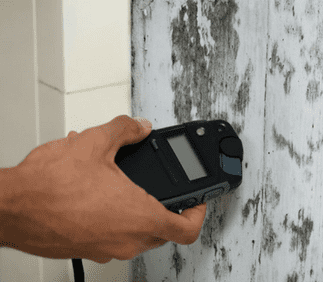
From there, the process moves through five documented steps: air sampling to capture airborne spore counts, surface swab collection from suspected growth areas, water intrusion inspection to identify the moisture source, moisture level measurement throughout the property, and full photographic documentation of every finding. One component that matters specifically in this agricultural community is the internal-versus-external spore comparison. Because properties near active vineyards and farmland like those around Paumanok Vineyards naturally have elevated outdoor fungal activity, comparing indoor and outdoor samples is the only accurate way to determine whether elevated readings inside represent a real problem or just the surrounding environment.
If there’s reason to suspect mold behind walls or under flooring, we use infrared thermal imaging to detect moisture and temperature differentials that indicate hidden growth without opening up walls unnecessarily. Everything collected goes to a certified, accredited laboratory. The written report you receive includes species identification, spore concentration data, moisture source findings, and specific remediation recommendations in plain language the kind of documentation that holds up with insurance companies, real estate attorneys, and buyers.
Ready to get started?
Indoor Air Quality Testing for Mold Aquebogue, NY
This isn’t a visual scan with a flashlight and a clipboard. Our mold inspection in Aquebogue includes air testing for airborne spore sampling, swab sampling from surface areas of concern, a water intrusion inspection to trace moisture back to its source, moisture level measurements taken throughout the property, and a complete photographic record of all findings. Infrared thermal imaging is used when the inspection warrants it particularly in older homes along the Route 25 corridor where construction predates modern vapor barriers and insulation standards.
Every sample goes to an accredited laboratory. The written report comes back with specific mold species identified, spore counts, moisture source documentation, and clear next steps. There’s no verbal summary that disappears after the call you get a document you can use.
For homeowners in Aquebogue dealing with a post-storm situation, a pre-sale disclosure need, or a seasonal property that’s been closed up through a Long Island winter, the full inspection scope matters. We’re also licensed for mold remediation, so if the report reveals something that needs to be addressed, you’re not starting over with a new contractor. Our licensed team handles assessment, remediation, and reconstruction if structural repairs are needed which is a real advantage in a rural market where coordinating multiple qualified tradespeople along the North Fork can be harder than it sounds.
Do I need a mold inspection after the 2024 North Fork flooding in Aquebogue?
If your property experienced any water intrusion during the August 2024 flooding event even what seemed like minor basement seepage a professional mold inspection is worth doing. Mold colonization can begin on porous materials within 24 to 72 hours of standing water. By the time visible growth appears, it’s typically been active for weeks. Many homeowners in the Aquebogue and Riverhead area dried out their basements after that storm and assumed the problem was resolved, only to discover significant mold growth months later when remediation costs were considerably higher.
A professional inspection with air sampling and moisture measurement will tell you whether mold has taken hold, where it’s concentrated, and what the moisture source is. If you filed or are considering filing an insurance claim for storm damage, the written lab report from a licensed mold assessor is exactly the kind of documentation insurers require. We handle insurance company communication directly, so you’re not navigating that process alone.
How much does a professional mold inspection cost in Aquebogue, NY?
A comprehensive mold inspection typically runs between $300 and $1,000 depending on property size and the scope of testing required. For a full inspection that includes air sampling, surface swabs, moisture measurement, infrared imaging where warranted, and an accredited lab report, you’re generally looking at the middle to upper end of that range somewhere around $500 to $700 for most residential properties in Aquebogue.
That cost needs to be weighed against what you’re protecting. With median home values in Aquebogue approaching $640,000 to $665,000, the financial exposure from an undetected mold problem is significant. A mold issue that reduces your home’s value by even 20 percent represents a loss of more than $125,000. The inspection cost is a small fraction of that risk. And if you’re purchasing a home on the North Fork, a mold inspection before closing is one of the more straightforward ways to protect yourself from inheriting a problem the seller may not have disclosed.
What's the difference between a mold inspection and a mold test?
These terms get used interchangeably, but they’re not the same thing. A mold test typically refers to a single type of sampling usually an air sample or a surface swab that tells you whether mold is present in a specific spot. A mold inspection is a broader process that includes physical assessment of the property, moisture source identification, multiple sampling types, and a comprehensive written report. Testing tells you if something is there. Inspection tells you what it is, where it’s coming from, and what to do about it.
For Aquebogue properties, a single air test often isn’t enough. The combination of coastal humidity from Flanders Bay, groundwater moisture intrusion in crawl spaces, and the elevated outdoor fungal environment from surrounding agricultural land means that interpreting results accurately requires comparing indoor and outdoor spore counts, measuring moisture levels throughout the structure, and identifying the source not just confirming presence. A full inspection gives you answers. A standalone test gives you a data point that may raise more questions than it answers.
Can mold grow in a home that doesn't have a basement in Aquebogue?
Yes and in Aquebogue specifically, homes without basements are not automatically lower risk. Crawl spaces are common in this area and present many of the same moisture challenges as basements, sometimes more so. An uninsulated crawl space sitting above soil in a high-water-table area near the Peconic River or Flanders Bay can accumulate ground moisture year-round, creating persistent humidity conditions that feed mold growth on floor joists, insulation, and subfloor materials. Because crawl spaces are rarely inspected casually, this type of mold often goes undetected for years.
Attics are another common location in older Aquebogue homes. Properties built before modern ventilation standards can trap moisture from interior living spaces particularly during Long Island’s humid summers and develop mold on roof sheathing and rafters without any active water intrusion event. Infrared thermal imaging is particularly useful in these spaces because it identifies moisture and temperature patterns that indicate hidden mold without requiring physical access to every corner of the structure.
Is there a conflict of interest when the same company does inspection and remediation?
It’s a fair question, and one worth asking any company you’re considering. The honest answer is that the inspection results are what they are they come from an accredited, independent laboratory, not from us. Spore counts, species identification, and moisture readings are objective data. They can’t be inflated to manufacture a remediation job, because the lab report is a document you receive and can have reviewed by anyone.
What the full-service model actually eliminates is the coordination burden on you. If the inspection reveals remediation is needed, you don’t have to find a second licensed contractor, schedule a second assessment, and wait for a second availability window. In a rural market like Aquebogue and the broader North Fork, finding qualified, licensed tradespeople quickly isn’t always straightforward. Having a team that is licensed for both mold assessment and mold remediation under New York State law and capable of handling reconstruction if structural repairs are needed means the project moves forward without delays that allow mold to continue spreading.
How does living near vineyards and farmland in Aquebogue affect mold test results?
It’s a real consideration that most general mold inspectors don’t account for. Properties near active vineyards and agricultural operations including those in the area around Paumanok Vineyards along Route 25 naturally have higher ambient outdoor fungal spore counts. This is normal. Soil, plant matter, and agricultural activity all produce fungal organisms that are part of the outdoor environment. They are not the same as the toxic indoor mold species that indicate a structural moisture problem.
The issue is that if an inspector only takes indoor air samples without collecting an outdoor control sample for comparison, elevated indoor readings can look alarming when they actually reflect the surrounding environment rather than a genuine indoor mold source. Our inspection process includes an internal-versus-external mold particle comparison as a standard component. This comparison is what allows the lab report to distinguish between outdoor agricultural spores that have drifted indoors and a true indoor mold colony that requires remediation. For Aquebogue homeowners, that distinction is the difference between an accurate answer and an unnecessary remediation project.
Useful Links
Other Services we provide in Aquebogue