
Hear from Our Customers

Patchogue sits where the Patchogue River meets the Great South Bay — and when a storm rolls through, water doesn’t just come from one direction. Bay Avenue has gone partially underwater from summer storms. Coastal flood warnings have projected two and a half to three feet of inundation in waterfront areas. If your home sits in one of Patchogue’s FEMA AE or VE flood zones, you already know this isn’t a hypothetical risk. It’s a recurring one.
What you get after calling us isn’t just a dry floor. It’s a home that’s been properly assessed with industrial moisture meters, dried through walls and subfloors — not just surfaces — and documented in a way that holds up when your insurance adjuster reviews the claim. That last part matters more than most people realize, especially in Patchogue where many homeowners carry both standard homeowners insurance and a separate National Flood Insurance Program policy. Knowing which one applies, and making sure the damage is recorded correctly to support the right claim, is where a lot of restoration jobs go sideways.
Beyond the paperwork, you’re also getting peace of mind that the job was done right the first time. Mold can begin forming within 24 to 48 hours of a water event. A surface cleanup that leaves hidden moisture behind a wall or under a subfloor isn’t a cleanup — it’s a delayed problem. When we finish the work, it’s done to IICRC standards, by certified technicians, with the kind of equipment that reaches places a box fan never will.
We’ve been serving Long Island homeowners for nearly three decades. That’s not a corporate timeline built through acquisitions — it’s real accumulated experience working in Patchogue and surrounding South Shore homes, through nor’easters, through Sandy, and through the kind of everyday pipe failures that don’t make the news but still flood a basement at two in the morning.
We’re headquartered in West Babylon, on the same South Shore corridor as Patchogue, roughly 15 to 20 miles west via Sunrise Highway. When you call our Suffolk County line — 631-587-5300 — you’re reaching a local team, not a regional dispatch center routing calls from out of state. Our technicians are IICRC-certified, and we’re licensed, bonded, and insured. That matters in a community like Patchogue, where unlicensed contractors have historically targeted homeowners after South Shore flooding events.
We know Long Island’s housing stock, we know Suffolk County’s insurance landscape, and we’ve been doing this work long before most of the competitors on this block had a website.
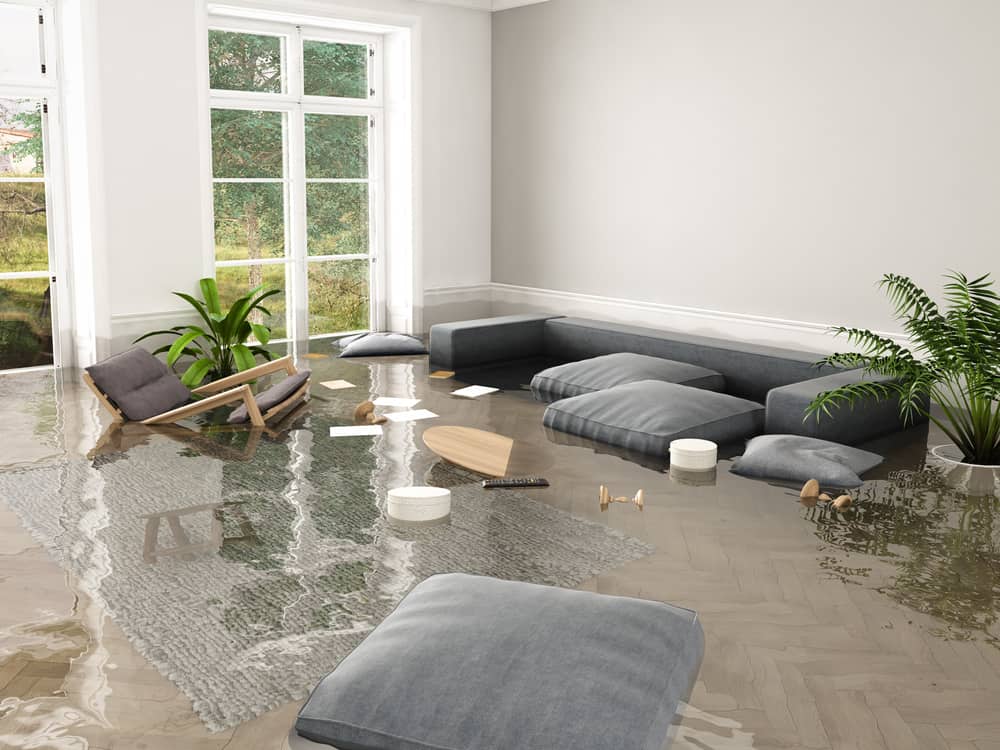
When you call, our first priority is getting someone to your property fast. Water damage doesn’t pause while you wait, and in Patchogue’s older housing stock — where roughly one in four homes was built before 1939 — water moves quickly into plaster walls, original hardwood floors, and structural cavities that were never designed with modern moisture barriers in mind. We respond 24/7 because that’s when storms actually hit.
On arrival, we assess the full scope of the damage, including what you can’t see. Moisture meters and thermal imaging identify water that has wicked behind baseboards, under flooring, or into wall cavities. This matters especially in Patchogue homes connected to on-site septic systems or cesspools rather than a municipal sewer — because if storm flooding has pushed sewage contamination into your basement, that changes the entire remediation protocol. That’s a Category 3 water event, and it requires a different level of response than a burst pipe. We identify this on arrival and adjust accordingly.
From there, we deploy industrial extraction equipment to remove standing water, commercial air movers and dehumidifiers to begin the structural drying process, and antimicrobial treatment where needed. Throughout the job, everything is documented — photos, moisture readings, scope of work — in a format that supports your insurance claim. If your home requires structural repairs or reconstruction after the restoration phase, we handle that too. One call covers the full process, from water removal through rebuild. And because the Village of Patchogue’s Building Department requires permits for structural and plumbing work, we operate within those requirements, not around them.

Ready to get started?
Water damage restoration in Patchogue isn’t one-size-fits-all. The village’s geography — tidal river to the north, Great South Bay to the south, FEMA AE and VE zones through the residential core — means the type of water intrusion varies significantly depending on where your home sits and what caused the event. Storm surge from the bay behaves differently than river overflow, and both behave differently than a burst pipe in a pre-war home on a cold January night.
For homes in South Patchogue and along the Patchogue River corridor, storm-related flooding is the most common scenario. For older homes throughout the village — particularly those with the cast-iron drain lines and galvanized supply pipes that have been flagged as past their intended lifespan in Patchogue’s older sections — internal pipe failure is a year-round risk. For the newer condo and townhouse developments near downtown, shared infrastructure means one unit’s water event can quickly become a multi-unit problem that involves property managers and HOA insurance policies.
We handle all of it: water removal and basement water extraction, structural drying, mold remediation, sewage backup cleanup, burst pipe water damage response, fire and smoke damage, and full reconstruction. We work directly with your insurance company — including helping you navigate the homeowners versus flood insurance question that trips up a lot of Patchogue homeowners in FEMA flood zones. No named service tiers, no upsells — just a clear assessment of what needs to happen and a team that does it.

This is one of the most important questions Patchogue homeowners face, and the answer depends entirely on the source of the water. Standard homeowners insurance covers sudden, accidental water damage from internal sources — a burst pipe, an appliance overflow, a roof leak from a storm. It does not cover flooding. If water entered your home because the Great South Bay surged during a storm, or because the Patchogue River overflowed its banks, that is flood damage — and it is only covered if you have a separate National Flood Insurance Program policy.
Many Patchogue homeowners in FEMA AE and VE zones carry both policies, which creates a documentation challenge: the damage needs to be recorded in a way that correctly identifies the water source and supports the right claim. Filing under the wrong policy — or failing to document the distinction clearly — can result in a denied claim. We work directly with your insurance company and help ensure the damage is documented accurately from the start, which is one of the most practical things a restoration company can do for a Patchogue homeowner navigating dual coverage.
Mold spores can begin germinating within 24 hours under the right conditions, and in Patchogue’s humid coastal environment — especially during the warmer months when bay breezes keep moisture levels elevated — those conditions are easy to meet. Visible mold growth typically appears within 48 to 72 hours, but microscopic growth starts earlier. By the time you can see it, you already have a mold problem.
This is why the response window matters so much. A flood event that happens on a Saturday night and gets addressed Monday morning has already given mold a significant head start. Professional extraction and structural drying equipment — commercial-grade dehumidifiers, air movers, and moisture meters — removes moisture from inside walls and subfloors where consumer fans simply cannot reach. Getting that equipment running within the first 24 hours is the most effective thing you can do to prevent a water damage event from becoming a mold remediation job on top of everything else.
Yes, significantly. The Village of Patchogue’s own documentation confirms that most homes in the village rely on on-site septic systems — cesspools — rather than a municipal sewer connection. When a storm event overwhelms a cesspool or saturates the soil around it, the water backing up into your basement is not clean water. It is classified as Category 3 — what the industry calls black water — which carries sewage contamination and requires a fundamentally different remediation protocol than a burst pipe or a roof leak.
Category 3 water events involve stricter safety protocols, more thorough antimicrobial treatment, and in many cases, the removal of porous materials like drywall and carpet that cannot be adequately decontaminated. Attempting a DIY cleanup in this situation is genuinely hazardous. Our IICRC-certified technicians identify the water category on arrival and adjust the entire scope of work accordingly. If you experienced basement flooding during a storm and your home has a cesspool, it’s worth having a professional assess what you’re actually dealing with before assuming it’s a straightforward drying job.
For most water damage scenarios — a burst pipe, an appliance overflow, moderate storm flooding — the drying phase alone typically takes three to five days using commercial-grade equipment. Water extraction itself usually takes one to three days depending on the volume of water and the materials affected. When you factor in any needed structural repairs or reconstruction, a moderate water damage event in a typical Patchogue home runs about two to three weeks from start to finish.
That timeline can extend in older homes, which make up a significant portion of Patchogue’s housing stock. Pre-war construction — plaster walls, original hardwood floors, older framing — holds moisture differently than modern drywall and engineered lumber. It often takes longer to dry and requires more careful monitoring to confirm the structure has reached acceptable moisture levels before repairs begin. Rushing that phase is one of the most common mistakes in water damage restoration, and it leads to mold problems weeks later that end up costing more than the original event.
The first thing to do is make sure it is safe to enter the space. If there is any chance the flooding reached electrical outlets, panels, or appliances, do not go in until the power to that area has been shut off. Standing water and live electricity is a serious hazard. Once you have confirmed it is safe, call a restoration company — do not wait to see how much water remains after it recedes naturally, because every hour of standing water increases the damage to floors, walls, and structural materials.
Document everything before anything is moved or removed. Take photos and video of the water level, the affected areas, and any visible damage. This documentation is critical for your insurance claim, whether you are filing under a standard homeowners policy or an NFIP flood policy. If your home has a cesspool and the flooding happened during a storm, note that for the restoration team when you call — it affects how the job is classified and handled. Do not attempt to clean up with a shop vac and fans and assume the problem is resolved. Hidden moisture in walls and subfloors is the source of most mold problems that show up weeks after an apparent cleanup.
A burst pipe is generally covered under standard homeowners insurance because it qualifies as sudden and accidental water damage — the category insurers cover. What they do not cover is damage from a pipe that failed gradually due to age or lack of maintenance. This distinction matters a great deal in Patchogue, where older homes in the village commonly have cast-iron drain lines and galvanized supply pipes well past their intended lifespan. If your insurer determines that a pipe failed due to corrosion that developed over years rather than a sudden event, they may deny the claim.
The best thing you can do is document the damage thoroughly and immediately — photos, video, timestamps — and call a restoration company before you call your insurer. Having a professional on-site to assess and document the scope of damage before an adjuster arrives strengthens your claim. We handle direct insurance coordination, which means we work with your insurer on your behalf and ensure the damage is recorded in a format that supports the strongest possible outcome for your specific situation.
Useful Links
Other Services we provide in Patchogue