
Water Damage Restoration in Port Jefferson Station, NY
When 9.83 Inches Falls Overnight, Your FEMA Zone Means Nothing
Hear from Our Customers

Flood Restoration Services in Port Jefferson Station
The goal isn’t to get the visible water up and call it done. The goal is to make sure your home is actually dry inside the walls, under the floors, behind the drywall in that finished basement so you’re not dealing with a mold problem three months from now. That’s what professional water damage restoration actually means, and it’s the difference between a job that holds and one that doesn’t.
Port Jefferson Station’s housing stock makes this especially important. Most homes here were built between the 1950s and 1970s, when Nesconset Highway opened up the hamlet to suburban development. Ranch-style homes, Cape Cods, and split-levels from that era were not built with modern waterproofing standards. Their concrete block foundations absorb moisture. Their finished basements a defining feature of the era trap water behind drywall and under flooring where consumer-grade equipment simply cannot reach it.
When we complete a job in Port Jefferson Station, you get moisture readings, documented drying progress, and a restoration that’s built to last not a surface cleanup that looks fine until it doesn’t. That’s the outcome that matters, and it’s the only one worth paying for.
Residential Water Damage Repair in Suffolk County
We’ve been serving Long Island homeowners for close to three decades. That’s not a number on a website it’s a track record that includes nor’easters, hurricanes, frozen pipe seasons, and the kind of extreme rainfall events that have become more frequent across northern Suffolk County. We know the housing stock in Port Jefferson Station, the drainage patterns that affect the Brookhaven area, and the specific conditions that challenge homes built in the 1950s through 1970s.
When you call our 631 number, you’re reaching a Suffolk County team not a national call center routing your job to whoever’s available. We serve Port Jefferson Station directly, with IICRC-certified technicians who are licensed, bonded, and insured, and who understand what post-flood repair work requires under the Town of Brookhaven Building Division’s guidelines.
We also work directly with your insurance carrier. We handle the documentation, the communication, and the paperwork so you’re not stuck in the middle trying to translate damage reports into claim language while also managing a disrupted household.
24/7 Water Damage Restoration Process in Port Jefferson Station
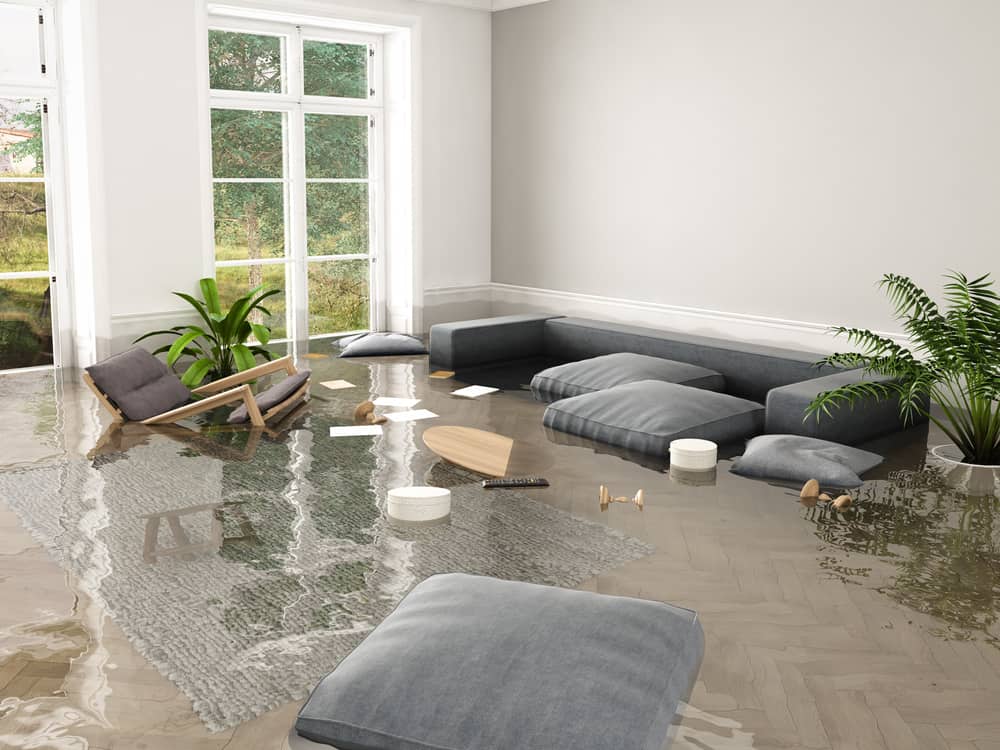
It starts the moment you call. Whether it’s a burst pipe discovered at midnight or a flooded basement you walked into after a long commute home on the Port Jefferson Branch, we respond around the clock. A team is dispatched, and the first priority on arrival is stopping any ongoing water source and beginning extraction immediately because every hour water sits in a 1970s ranch home with a finished basement is an hour closer to mold.
After extraction, we use industrial-grade air movers, dehumidifiers, and thermal imaging to map moisture inside wall cavities, under flooring, and behind finished surfaces. This is the step most homeowners don’t see and the one that matters most. Drying typically takes three to five days, with moisture readings taken throughout to verify that the structure is reaching IICRC drying standards, not just feeling dry to the touch.
Once the structure clears, the restoration phase begins. That can mean anything from replacing drywall and flooring in a finished basement to full structural repairs, depending on the scope. Because we handle the entire job extraction through rebuild there’s no gap between the cleanup crew and the contractor. The documentation we generate throughout the process is formatted for insurance adjusters, which matters especially in Port Jefferson Station, where many homeowners are navigating the coverage gap between standard homeowners policies and the flood coverage they may not have purchased.
Ready to get started?
Burst Pipe and Storm Damage Restoration in Port Jefferson Station
Water damage in Port Jefferson Station doesn’t come from one source. It comes from the August storm that drops nearly 10 inches overnight. It comes from the galvanized pipe in a 1960s Cape Cod that finally gives out on a Tuesday morning while you’re on the LIRR heading into the city. It comes from the sump pump that couldn’t keep up with a spring thaw, or the washing machine supply line that failed behind a finished wall. We’re set up to handle all of it.
The core services we offer for Port Jefferson Station homeowners include emergency water removal and basement water extraction, structural drying and dehumidification, mold prevention treatment, flooded basement cleanup, storm damage restoration, burst pipe water damage response, and full reconstruction of finished spaces. For homes where the damage triggers permit requirements under the Town of Brookhaven Building Division which applies to structural repairs, electrical work, and significant demolition we’re familiar with what that process involves and how to move through it without adding unnecessary delays.
There are no named service tiers or packages. The scope of work is determined by what your home actually needs, documented from the first moisture reading through final clearance. The goal is a complete restoration not a minimum viable cleanup and the insurance coordination built into our process is designed to help you recover as much of that cost as your policy allows.

Does homeowners insurance cover the flooding Port Jefferson Station experienced in August 2024?
This is one of the most important questions coming out of that storm, and the answer depends on what caused the water to enter your home. Standard homeowners insurance covers sudden, accidental water damage from internal sources a burst pipe, an appliance failure, a roof breach from wind. What it does not cover is flooding, which the insurance industry defines as water that originates outside the home and enters through the ground, storm drains, or surface runoff.
Port Jefferson Station is classified as FEMA Flood Zone X, which means flood insurance is not federally required and many homeowners here have not purchased a separate flood policy. If the water that entered your basement during the August 2024 storm came from overwhelmed drainage systems or groundwater intrusion which is what happened in many homes along the Route 112 corridor your standard policy may not cover it. That’s a hard conversation, but it’s better to understand it upfront than to file a claim and be blindsided by a denial. We work directly with your insurer from the start, document the damage in the format adjusters require, and help you understand exactly what you’re working with before any decisions are made.
How quickly can mold develop after a basement floods in a Port Jefferson Station home?
The EPA is clear on this: mold growth can begin within 24 to 48 hours of water exposure under the right conditions. In a finished basement which is standard in most of Port Jefferson Station’s ranch-style and split-level homes those conditions are almost always present. Drywall, carpet padding, wood framing, and insulation all absorb moisture quickly and release it slowly. Once mold begins colonizing inside a wall cavity or under a finished floor, it is no longer a drying problem. It is a remediation problem, and the cost and scope of that work is significantly greater.
This is why the timing of your call matters. If you came home from work and found water in your basement, the clock started before you walked in the door. Our 24/7 emergency response exists precisely because water damage does not wait for business hours and in a commuter community like Port Jefferson Station, where many homeowners are away from their homes for 10 or more hours a day, the gap between when damage starts and when it’s discovered can already be significant by the time anyone calls.
What does water damage restoration actually cost, and will my insurance cover it?
Nationally, the average cost of water damage restoration runs around $3,864, though the range is wide from a few hundred dollars for a minor, contained incident to well over $10,000 for extensive flooding with structural damage or mold involvement. The final number depends on the category of water involved, how much of the structure was affected, how long the water sat before extraction began, and whether finished surfaces like drywall, flooring, or cabinetry need to be replaced.
As for insurance: if the damage came from a sudden, accidental internal source a burst pipe, a failed water heater, an overflowing appliance your standard homeowners policy is likely to cover a significant portion of the restoration cost. If the water came from outside the home during a storm event, coverage depends on whether you carry a separate flood policy. We document your damage thoroughly from the first assessment, in a format your insurance adjuster will recognize. That documentation is one of the most important factors in how your claim is evaluated, and it’s something we handle as part of every job.
My Port Jefferson Station home was built in the 1960s does that affect how water damage is handled?
It does, and it’s worth understanding why. Homes built in the 1950s through 1970s which make up a large portion of Port Jefferson Station’s housing stock were constructed with materials and methods that are now 50 to 70 years old. Concrete block foundations from that era were not sealed to modern waterproofing specifications, which means they are more permeable to groundwater during heavy rain events. Galvanized steel and early copper plumbing systems from this period are at or near the end of their service life, making them more susceptible to pinhole leaks, joint failures, and freeze-related bursts during cold snaps.
Finished basements a defining feature of the ranch and split-level homes that dominate Port Jefferson Station add another layer of complexity. Water that enters a finished basement contacts drywall, carpet, drop ceilings, and wood framing simultaneously. These materials absorb moisture quickly and are slow to release it, which means a finished basement in an older home requires more aggressive drying protocols and more thorough moisture verification than an unfinished space. Our team is experienced with this specific building profile and calibrates the drying process accordingly not to a generic standard, but to what that particular home actually needs.
How long will water damage restoration take in my home?
The honest answer is that it depends on the scope of the damage, but here’s a realistic framework. For a typical flooded basement in a Port Jefferson Station ranch or split-level one room, moderate water intrusion, no structural compromise the water extraction phase takes one to three days, and the structural drying phase runs another three to five days. After that, if finished surfaces need to be replaced, the reconstruction timeline varies based on what was damaged and what permits may be required.
For more extensive damage multiple rooms affected, water that sat for an extended period before extraction, or situations where mold has already begun developing the timeline extends accordingly. The Town of Brookhaven Building Division requires permits for certain types of post-flood reconstruction work, including structural repairs and electrical work, and that permitting process adds time that needs to be factored into any realistic timeline. We’ll give you a clear picture of the expected timeline after the initial assessment, so you’re not managing uncertainty on top of an already stressful situation.
How do I know if the water damage in my basement was fully dried, or just looks dry?
This is the right question to ask, and most homeowners don’t ask it until they’re dealing with a mold problem months later. The surface of a wall or floor can feel and look completely dry while the interior the drywall core, the insulation behind it, the wood framing, the subfloor is still holding significant moisture. Consumer-grade fans and dehumidifiers move air across surfaces. They do not generate the airflow and extraction capacity needed to dry structural cavities in a 1960s or 1970s ranch home with a finished basement.
Professional restoration uses moisture meters and thermal imaging to measure what’s actually happening inside the structure, not just on the surface. IICRC drying standards define specific moisture thresholds that must be reached before a structure is considered dry and those readings are documented throughout the process. When we complete a job in Port Jefferson Station, you receive documentation showing that the structure reached those thresholds, not just a visual inspection and a handshake. That documentation also matters for your insurance claim and for your own peace of mind if you ever decide to sell the home a properly closed restoration file is a verifiable record that the problem was resolved completely.
Useful Links
Other Services we provide in Port Jefferson Station