
Mold Inspection in Long Beach, NY
When Your Whole City Is a Flood Zone, Guessing Isn't Good Enough
Hear from Our Customers
Mold Testing in Long Beach, NY
There’s a specific kind of stress that comes with owning a home in Long Beach. You know the flood risk is real FEMA made the entire city a Flood Zone AE designation official back in 2009. You’ve probably been through at least one storm event, maybe Sandy, maybe a nor’easter that pushed water somewhere it shouldn’t have gone. And somewhere in the back of your mind, you’ve wondered whether everything dried out the way it was supposed to.
That’s exactly where professional mold inspection in Long Beach, NY earns its value. A thorough inspection tells you what’s actually there not what looks fine on the surface. In a city where ocean humidity, salt air, and tidal surge are facts of life year-round, mold doesn’t need a dramatic flood event to get started. It needs moisture and time. Older homes along the President Streets, canal-front properties in the Canals neighborhood, and high-rise condos along the boardwalk all face different exposure patterns but the same underlying risk.
What you get from a proper inspection isn’t just peace of mind. It’s documentation our insurance company will accept, a clear answer before a real estate closing, and a specific plan if something is found. No vague verbal assessment. No guesswork. Just lab-backed results and a written report that tells you exactly where you stand.
Mold Inspection Company in Long Beach, NY
We’ve been serving Nassau and Suffolk County for over three decades. That means we were working on Long Island long before Sandy reshaped the South Shore, and long before FEMA remapped Long Beach into the highest flood risk category. That kind of history isn’t just a number it’s institutional knowledge about how barrier island homes age, how post-flood moisture behaves, and what a proper inspection actually requires in this environment.
Our owner, Richard Peterson, holds a New York State Department of Labor license in both mold assessment and mold remediation which is a legal requirement in this state, not a bonus credential. Every technician on our staff carries IICRC certification. The person who walks through your Long Beach home, collects air samples, and runs the infrared scanner isn’t a trainee. They’re a certified professional held to the same standard as the owner.
We’re fully licensed, bonded, and insured, and available 24 hours a day, seven days a week. In a city where the next storm is always a season away, that availability matters.
Professional Mold Assessment in Long Beach, NY
The inspection starts before we touch a wall. Our technician reviews the property layout, identifies known water intrusion points, and asks the right questions when did you last have flooding, where’s the musty smell strongest, has the HVAC been serviced recently. In Long Beach, those questions often lead directly to the areas of highest concern: crawl spaces in canal-front homes, attic assemblies in pre-war construction along the Walks, and shared mechanical rooms in oceanfront condo buildings.
From there, the process moves through air sampling, surface swab collection, and moisture level measurement throughout the property. One of the more important steps and one that a lot of inspectors skip is the comparison of indoor air samples against outdoor baseline levels. In a coastal environment like Long Beach, ambient mold spore counts outside are naturally elevated by ocean humidity. Without that baseline comparison, indoor results can look alarming when they’re actually within normal range, or look fine when they’re actually not. That context is what turns a lab result into a meaningful answer.
We use infrared thermal imaging to scan walls, ceilings, and floors for hidden moisture without opening anything up. All samples go to a certified laboratory. When results come back, you receive a written report that includes mold species identification, spore concentration data, and a specific remediation recommendation if one is warranted. That report is built to hold up with your insurance adjuster, your real estate attorney, or your lender.
Ready to get started?
Residential Mold Inspection Services in Long Beach, NY
Long Beach isn’t a typical Nassau County suburb, and a mold inspection here shouldn’t be treated like one. The housing stock alone tells the story roughly a quarter of homes in the city were built before 1939, which means aging plumbing inside wall cavities, roof systems that weren’t designed for modern moisture management, and attic ventilation that was never adequate for the sustained coastal humidity this island sees year-round. A surface-level visual check doesn’t cut it here.
Our inspection covers air quality testing with indoor-to-outdoor particle comparison, swab sampling from suspect surfaces, moisture mapping across the full property, and infrared scanning to locate hidden water damage behind walls and under floors. For condo and co-op owners along the boardwalk or in North Park, we account for moisture migration between units a real and common issue in multi-unit buildings where a water intrusion two floors up can produce mold growth in your unit with no visible source. For single-family homes in the Canals neighborhood, the crawl space and subfloor assemblies get close attention, because chronic bay-side moisture in those properties tends to accumulate where you can’t see it.
We handle the full path from inspection through remediation and restoration so if something is found, you’re not starting over with a different company. One call, one team, one standard of accountability from the first air sample to the final clearance report.
Does my Long Beach home need a mold inspection after flooding?
If your home took on water from a nor’easter, a tidal surge through Reynolds Channel, a storm drain backup, or a pipe failure a mold inspection is worth doing within a reasonable window after the event. Mold can begin growing within 24 to 48 hours of water contact, and in a FEMA Flood Zone AE city like Long Beach, the volume and speed of water intrusion during storm events creates ideal conditions for rapid growth. The problem is that mold often starts in places you can’t see: inside wall cavities, under subfloor assemblies, behind baseboards, and in HVAC systems that pulled moisture-laden air during the event.
A professional inspection after flooding isn’t just about finding visible mold. It’s about confirming that moisture levels throughout the structure have returned to safe baseline levels and that no hidden colony is developing in a wall you can’t open without reason. Many Long Beach homeowners who went through Sandy remediation in 2012 and 2013 later discovered mold resurfacing in areas that weren’t fully dried in the original response. An inspection now is cheaper than a full remediation later.
What does a mold inspection in Long Beach, NY actually include?
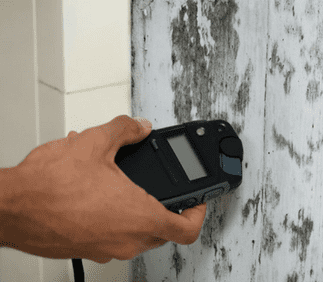
A thorough mold inspection in Long Beach goes well beyond a visual walkthrough. It includes air sampling at multiple points throughout the property, surface swab collection from suspect areas, moisture level measurement with calibrated meters, infrared thermal imaging to detect hidden moisture in walls and ceilings, and a comparison of indoor air quality against outdoor baseline levels. That last piece is especially important in a coastal environment Long Beach’s ocean and bay exposure means ambient outdoor mold spore counts are naturally higher than in inland Nassau County towns, and your indoor results need to be interpreted against that local baseline to be meaningful.
All samples collected during the inspection go to a certified third-party laboratory. You receive a written report that includes mold species identification, spore concentration data, moisture readings, and a specific remediation recommendation if one is warranted. That report is accepted by insurance companies, real estate attorneys, and lenders which matters in a market where property values approach or exceed $900,000 and documentation quality directly affects claim and transaction outcomes.
How do I know if the musty smell in my home is actually mold?
A musty smell is one of the most reliable early indicators of mold growth but it doesn’t tell you where the mold is, what species it is, or how concentrated the spore count has become. In Long Beach homes, that smell most commonly originates in areas with chronic moisture exposure: crawl spaces in canal-front properties, attic assemblies in pre-war construction where ventilation was never adequate, and wall cavities near windows or exterior walls that have weathered years of salt air and storm-driven rain.
The challenge is that mold producing a noticeable odor is often well-established by the time you smell it, and it’s frequently located somewhere that a visual inspection won’t reach. Infrared thermal imaging and air sampling are the tools that bridge that gap they can locate the moisture source driving growth and quantify what’s in the air, even when nothing is visible on the surface. If you’re smelling something you can’t explain, a professional inspection is the only way to get a definitive answer rather than a guess.
Can mold grow inside a Long Beach condo or co-op unit?
Yes and in multi-unit buildings, the source of a mold problem in your unit is often somewhere else entirely. High-rise condominiums and apartment buildings along Long Beach’s oceanfront boardwalk have shared wall assemblies, common HVAC systems, pipe chases that run between floors, and rooftop mechanical equipment all of which can carry moisture from one unit into another without any visible sign of water damage in the affected space. A water intrusion two floors above you can produce mold growth behind your bathroom wall with no leak you’d ever see.
This is one of the reasons infrared thermal imaging is particularly useful in Long Beach’s condo and co-op inventory. It can identify moisture migration through shared assemblies without destructive access which matters both for identifying the actual source and for any conversation with building management or a co-op board about responsibility. If you’re experiencing unexplained odors, respiratory irritation, or visible discoloration in a unit that has never had a direct water event, the source may be above, below, or beside you.
Is mold from Superstorm Sandy still a problem in Long Beach homes today?
For some properties, yes. Sandy made landfall in October 2012, and the emergency remediation that followed was done quickly and under difficult conditions. In cases where moisture wasn’t fully eliminated from wall cavities, subfloor assemblies, or HVAC systems before materials were closed back up, dormant mold colonies can remain inactive for years and then reactivate when conditions allow a new roof leak, a humid summer with the AC off, or a slow plumbing drip that goes unnoticed for months.
Research documented one year after Sandy found mold resurfacing in Long Beach-area buildings that had already undergone remediation including schools and residential structures. If your home was affected by Sandy and you haven’t had a professional inspection since the original remediation work was completed, there’s no reliable way to know whether the problem was fully resolved. An inspection with infrared scanning and air sampling can confirm clearance or identify what’s still there whichever answer is true.
Does New York State require a licensed inspector for mold assessment in Long Beach?
Yes. New York State has required all mold assessors and remediation contractors to hold a valid license issued by the NYS Department of Labor under Article 32 of the NY Labor Law since January 1, 2016. Working with an unlicensed inspector isn’t just a credentialing issue it’s a practical one. Reports produced by unlicensed individuals carry no legal standing in New York, which means they’re useless for insurance claims, real estate transactions, landlord-tenant disputes, or any other situation where documentation needs to hold up. Fines for unlicensed mold work in New York can reach $10,000.
In Long Beach specifically, where flood insurance claims, post-Sandy documentation, and high-value real estate transactions are common, the licensing requirement isn’t a technicality it’s the baseline. We hold current NYS DOL licenses in both mold assessment and mold remediation. When you receive a report from us, it’s a document produced by a licensed assessor that will be accepted by your insurance carrier, your attorney, and your lender without question.
Useful Links
Other Services we provide in Long Beach