
Mold Inspection in East Farmingdale, NY
When a 60-Year-Old Home Stops Hiding Its Secrets
Hear from Our Customers
Residential Mold Inspection East Farmingdale, NY
There’s a specific kind of stress that comes with not knowing. You smell something in the basement. Someone in the house keeps getting sick. You’re about to close on a home in East Farmingdale that’s pushing $800,000 and you have no idea what’s living inside the walls. That uncertainty is exactly what a thorough mold inspection is designed to eliminate.
East Farmingdale’s housing stock is older most of it built between the 1940s and 1960s, when vapor barriers weren’t standard and moisture management wasn’t even a conversation builders were having. That means your home has had decades to accumulate the kind of hidden moisture conditions that mold feeds on: seeping concrete block basement walls, low-pitch attic spaces that trap heat and humidity through Long Island’s summers, crawl spaces that never fully dry out. These aren’t rare edge cases here. They’re common.
Once you have a documented inspection real lab results, not a visual guess you know exactly what you’re dealing with and where it is. That clarity lets you make decisions: whether to remediate before listing, what to negotiate in a purchase, or how to file an insurance claim. It also gives you something more immediate peace of mind that the air your family is breathing has been professionally evaluated, not just eyeballed.
Licensed Mold Inspector East Farmingdale, NY
We’re based in West Babylon same Town of Babylon, a few miles from East Farmingdale. This isn’t a company stretching its service map to add your zip code. We’ve been working in homes like yours, in towns like this one, for over three decades.
Every technician on our team carries IICRC certification not just ownership, every person who walks through your door. And because New York State requires mold assessors and remediators to hold a Department of Labor-issued license since 2016, you can verify our credentials directly through the NY DOL’s contractor search tool. That’s not something every company advertising mold services in the East Farmingdale area can say.
We also handle more than the inspection. If mold is found, we can remediate it. If structural materials need to come out, we can reconstruct. And if this is an insurance situation, we manage the documentation and communication from the first call through project close. One team. One point of contact. No juggling contractors while the problem gets worse.
Mold Assessment Services East Farmingdale, NY
The inspection starts with air testing pulling air samples from inside the home and comparing them against outdoor baseline levels. That comparison matters because elevated indoor spore counts relative to outdoor air is one of the clearest indicators of an active mold problem. Surface swab samples are collected from any visible growth or suspect areas to identify the specific mold species present.
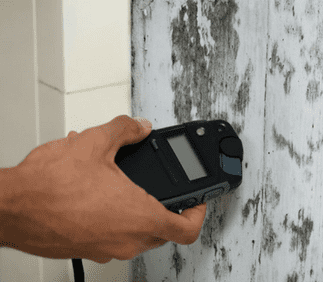
From there, the focus shifts to moisture because mold doesn’t exist without a water source. Every inspection we conduct includes a water intrusion assessment to identify where moisture is entering the structure, plus calibrated moisture meter readings at walls, floors, and ceilings throughout the home. In East Farmingdale’s older housing stock, that often means paying close attention to basement walls, attic decking, and bathroom assemblies that were never properly vented. Infrared thermal imaging is also used to detect temperature differentials that indicate hidden moisture behind walls and under floors areas a standard visual inspection simply can’t reach.
Everything gets photographed and documented. All samples go to an accredited laboratory for analysis. When the results come back, you receive a full written report in plain language mold species identified, spore concentrations, moisture sources found, and specific recommended next steps. Because New York State has specific licensing requirements for mold assessors, the report you receive from us is legally valid for insurance claims, real estate transactions, and any remediation planning that follows. That matters in a market where homes are selling above $800,000 and every detail of a transaction carries real financial weight.
Ready to get started?
Black Mold Testing East Farmingdale, NY
A mold inspection from us isn’t a walk-through with a flashlight. It’s a five-point process air testing, surface swab sampling, water intrusion inspection, moisture level measurement, and full photographic documentation backed by accredited laboratory analysis and delivered as a written report you can actually use.
The infrared thermal imaging component is worth calling out specifically because most inspection companies in the East Farmingdale area don’t offer it. For homes along the Farmingdale UFSD and Half Hollow Hills school district zones where a lot of the residential stock is post-war construction with wall assemblies that have never been opened thermal imaging is often the only way to find moisture that’s been trapped inside a wall cavity for years. It’s not a standard add-on here. It’s part of every inspection we perform.
For commercial property owners and managers along the Route 110 corridor, the same process applies with the documentation standards that commercial clients need for regulatory compliance and liability management. Whether you’re managing an office park, a warehouse, or an older industrial building near Republic Airport, we provide the same licensed, lab-verified inspection that residential clients receive with reporting that holds up for tenants, insurers, and property managers alike. Residential or commercial, the standard doesn’t change.
How much does a mold inspection cost in East Farmingdale, NY?
Mold inspection costs on Long Island typically range from around $300 to $700 for a standard residential inspection, depending on the size of the home and the scope of testing involved. Larger homes or inspections that require more extensive air sampling, additional swab collection, or infrared thermal imaging may fall toward the higher end of that range.
For East Farmingdale homeowners, it helps to think about that cost against the backdrop of what’s at stake. Median home sale prices in this area are pushing $820,000, and an undetected mold problem can reduce property value by 20% or more or kill a deal entirely. The inspection fee is a small fraction of what a missed mold problem can cost you in a real estate transaction, an insurance dispute, or long-term remediation. It’s not a luxury expense. It’s due diligence on one of the largest assets you own.
Does a mold inspector in New York need to be licensed to inspect my home?
Yes and this is one of the most important things to verify before hiring anyone for a mold inspection in East Farmingdale or anywhere else in New York State. Since January 1, 2016, New York law has required that mold assessors and mold remediators hold a license issued by the NY Department of Labor. This applies to anyone conducting a mold assessment or remediation in a residential or commercial property in the state.
You can verify a company’s license status directly through the NY DOL’s licensed contractor search tool online it takes about two minutes. If a company can’t provide a license number or doesn’t show up in that search, their inspection findings carry no legal weight. They can’t be used for insurance claims, real estate transactions, or remediation planning in any enforceable way. We hold both the mold assessor license and the mold remediator license, and both are verifiable through the state’s database.
What are the most common signs of mold in older East Farmingdale homes?
The most obvious sign is a persistent musty smell especially in basements, closets, or rooms that don’t get much airflow. But in East Farmingdale’s post-war housing stock, mold often doesn’t announce itself that clearly. A lot of it develops inside wall cavities, beneath flooring, or in attic insulation that’s been degrading for decades, and you won’t smell or see it until it’s been there a while.
Other signs to pay attention to: unexplained respiratory symptoms that improve when you leave the house, visible discoloration on walls or ceilings that keeps coming back after you paint over it, or a history of water intrusion a basement that floods seasonally, a roof that’s had repairs, old plumbing that’s leaked inside a wall. Homes built in the 1940s through 1960s, which make up the bulk of East Farmingdale’s residential neighborhoods, were constructed before modern moisture management standards existed. If your home is in that era, you don’t need a dramatic water event to have a mold problem. Chronic low-level moisture over decades is often enough.
Should I get a mold inspection before buying a home in East Farmingdale?
If the home was built before 1980 which covers most of East Farmingdale’s residential inventory a mold inspection before closing is a reasonable step, not an overreaction. Standard home inspections check for structural and mechanical issues, but they don’t include air sampling, moisture measurement, or laboratory analysis. A general home inspector can flag visible water staining, but they’re not equipped to tell you whether there’s active mold growth inside a wall assembly or what species are present in the air.
In a market where East Farmingdale homes are selling above $800,000 and competition is high, buyers sometimes skip additional inspections to move faster. That’s understandable, but it carries real risk with older homes. A mold problem discovered after closing becomes your problem entirely. Discovered before closing, it becomes a negotiating point or a reason to walk away before you’re legally committed. Given the financial stakes, the cost of a pre-purchase mold inspection is one of the easier decisions in the process.
Can mold grow in my attic or HVAC system, and how would I know?
Both are common and both are easy to miss without the right equipment. Attic mold in Long Island homes is typically caused by inadequate ventilation combined with humid summer air getting trapped under the roof deck. In East Farmingdale’s older Cape Cods and ranches, attic insulation that was installed decades ago may have degraded to the point where it’s holding moisture rather than blocking it. If your attic has poor ridge or soffit ventilation, mold on the underside of the roof sheathing is a real possibility even without a visible leak.
HVAC-related mold is a different problem. When evaporator coils or ductwork accumulate moisture which happens in older systems that cycle on and off through Long Island’s humid summers mold can grow inside the system and get distributed through the air every time it runs. If you’ve noticed a musty smell specifically when the AC kicks on, that’s worth investigating. Air sampling during a mold inspection will pick up elevated spore counts from HVAC-sourced mold even when there’s nothing visible in the living space.
What happens if mold is found during the inspection what are my next steps?
The inspection report will tell you what was found, where it is, what species are present, and what the recommended remediation approach is. From there, your next step depends on the severity and location of the growth. Minor surface mold in a low-risk area is a different situation than a colony inside a wall cavity or elevated airborne spore counts throughout the living space.
If remediation is needed, New York State law requires that the assessment and the remediation be handled by separately licensed parties meaning the same person can’t write the assessment report and then immediately perform the remediation without proper separation of roles. We hold both licenses and operate within those regulatory boundaries. For East Farmingdale homeowners dealing with mold connected to a water damage event a burst pipe, a flooded basement, a roof leak the remediation may also be an insurance matter. We handle the documentation and communication with your insurance company throughout the process, so you’re not navigating that on your own while also managing an active mold problem in your home.
Useful Links
Other Services we provide in East Farmingdale