
Hear from Our Customers
The air in your home feels different when the problem is resolved — not just painted over. No more musty smell in the basement, no more second-guessing whether that dark spot behind the drywall is something serious, and no more wondering if your family is breathing air that’s working against them. That’s what real mold remediation in South Huntington, NY delivers — not a surface treatment, but a documented resolution.
South Huntington’s housing stock tells a specific story. Most of the homes here were built between the late 1940s and the 1970s, during Long Island’s postwar suburban boom. Those homes have basements with aging concrete block foundations, crawl spaces that were never encapsulated, and attic ventilation systems that weren’t designed for the HVAC loads they’re carrying today. Add in Long Island’s humid summers — where outdoor humidity regularly hits 70 to 80 percent from May through September — and you have conditions where mold doesn’t need much of an invitation.
When remediation is done correctly, you walk away with more than a clean space. You have a clearance report that documents air quality results, which matters when you’re dealing with an insurance claim or a real estate transaction. In a market where homes near the Walt Whitman Shops corridor regularly sell above $700,000, that documentation isn’t a formality — it’s protection.
First Response Restoration and Cleaning Inc. has been doing this work on Long Island for approximately 31 years. That’s not a corporate timeline — that’s our owner, Richard Peterson, building this company from the ground up in South Huntington, Melville, Dix Hills, and across western Suffolk County, long before most of the current homeowners moved in.
Richard holds personal New York State licenses in both mold assessment and mold remediation. Not a company-level credential filed somewhere in a binder — his own license, issued under Article 32 of the Labor Law, verifiable through the NYS Department of Labor’s online registry. Every technician on our team is IICRC-certified, which means the people entering your home have been trained and tested to the industry’s governing standard, not just handed a company shirt.
This is an owner-operated business. There’s no franchise system, no corporate template, and no call center routing your emergency to whoever’s available. When you call First Response for mold remediation in South Huntington, NY, you’re dealing with a company where accountability starts at the top.

It starts with moisture mapping and source identification — not mold removal. That distinction matters more than most people realize. If the moisture source isn’t found and addressed first, the mold will return. In South Huntington’s postwar homes, that source is often hidden: a foundation crack that only weeps during heavy rain, a bathroom exhaust fan that was never properly vented to the exterior, or a crawl space with no vapor barrier letting ground moisture migrate up into the framing. Finding it is the first job.
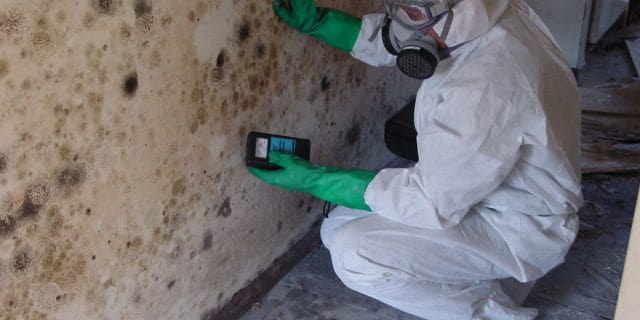
Once the source is identified, containment goes up — negative air pressure barriers that prevent mold spores from spreading to unaffected areas of your home during the remediation process. From there, contaminated materials are physically removed, affected surfaces are HEPA vacuumed, and EPA-registered antimicrobial treatment is applied. Structural drying follows to bring moisture levels down to a safe baseline. Under New York State’s Article 32 mold licensing law — which has been in effect since 2016 — this work must be performed by a licensed remediation contractor. We are fully licensed and compliant.
The process ends with post-remediation verification: independent air quality testing that confirms mold spore counts are back to normal levels. You receive a written clearance report. That’s the finish line — not when the equipment is loaded back into the truck, but when the documentation is in your hands.
Ready to get started?
Basement mold remediation is the most common call we receive in South Huntington, and it makes sense given the housing stock. Aging concrete block foundations, limited drainage capacity in older residential streets, and the seasonal nor’easters that push water through foundation walls — these are recurring conditions in the 11746 zip code, not rare events. We handle the full scope: containment, material removal, antimicrobial treatment, drying, and clearance documentation.
Attic mold remediation is the second most frequent issue, particularly in the cape cods and split-levels that define much of South Huntington’s residential character. Inadequate soffit ventilation combined with bathroom exhaust fans that vent into the attic rather than outside creates a moisture trap that shows up as mold on the roof sheathing and rafters — usually discovered during a home inspection or HVAC service call. Crawl space mold remediation is also common along the western edge of the community, where properties bordering the West Hills area have greater soil moisture and less natural drainage.
Beyond the structural remediation, our integrated cleaning division handles the full post-remediation cleanup — surfaces, contents, and affected areas — so you’re not coordinating a second company to finish the job. One call, one team, one clearance report.
Yes — and this is one of the most important things to verify before hiring anyone. New York State’s Article 32 of the Labor Law requires that anyone performing mold remediation hold a valid NYS Mold Remediation Contractor License. This law has been in effect since January 1, 2016, and it applies to every project in South Huntington and across Suffolk County, regardless of the size of the job.
Hiring an unlicensed contractor creates real exposure for you as a homeowner. Your insurance company can deny a claim if the remediation was performed without proper licensure. The work may not meet the legal standard, which means you could be left with a recurring problem and no legal recourse. You can verify any contractor’s license through the NYS Department of Labor’s online registry — and you should, before anyone starts work in your home.
We hold all required licenses under Article 32. Richard Peterson’s personal mold assessment and remediation licenses are verifiable through the state registry. That’s not a marketing point — it’s the baseline standard every homeowner in South Huntington deserves to expect.
The honest answer is that it depends on where the mold is, how far it’s spread, and whether the moisture source has caused structural damage. For most residential projects in the South Huntington area, you’re generally looking at a range somewhere between $1,500 and $6,000 for contained remediation in a single area like a basement or attic. Projects involving significant material removal, crawl space encapsulation, or multiple affected zones can run higher.
What drives cost up most consistently is delayed response. Mold begins growing within 24 to 48 hours of water intrusion, and the longer it’s left, the deeper it penetrates into building materials. A basement flood that gets addressed within 24 hours is a very different scope than the same basement discovered three weeks later. In South Huntington’s postwar homes, where plumbing systems are aging and foundation waterproofing has often never been updated, that window closes faster than most homeowners expect.
The clearest way to get an accurate number is a proper assessment — not a phone estimate. We provide written estimates based on what’s actually there, not a range designed to get a foot in the door.
Mold removal implies that you can simply take mold out of a space and the problem is solved. Mold remediation is a broader, more accurate term for what actually needs to happen: identifying the moisture source, containing the affected area, removing contaminated materials, treating surfaces with EPA-registered antimicrobials, drying the structure to safe moisture levels, and verifying through air quality testing that spore counts are back to normal.
The distinction matters in practice because mold is not just a surface issue. It grows into porous materials — drywall, wood framing, insulation — and removing what’s visible without addressing the underlying moisture and the affected substrate means it will return. In South Huntington’s older homes, where mold is often found behind finished basement walls or inside crawl space framing, surface-only treatment is essentially a temporary cosmetic fix.
When you see the term mold remediation used by a licensed contractor, it should mean the complete process — source identification through post-remediation verification. If a company’s scope of work stops at cleaning visible surfaces, that’s mold removal at best, and it’s not the standard New York State’s Article 32 licensing law was written to enforce.
It depends on the scope and location of the work. For smaller, contained remediation projects — a single basement room, a section of a crawl space, or a portion of an attic — most homeowners can remain in the home during the process, as long as proper containment barriers are in place and negative air pressure is maintained. The containment system is specifically designed to prevent spores from migrating to unaffected living spaces.
For larger projects involving multiple zones, significant material removal, or mold in HVAC-adjacent areas, temporary relocation during the active remediation phase is often the more practical choice — both for your comfort and to reduce any potential exposure risk during the work itself. This is especially worth considering in households with young children, elderly residents, or anyone with asthma or respiratory sensitivities, which is a real consideration in South Huntington’s family-oriented community.
The assessment phase will give you a clear picture of scope, and that’s when the question of displacement should be addressed directly. We’ll give you a straight answer based on what we actually find — not a blanket recommendation in either direction.
In South Huntington specifically, the answer comes back to the same two factors almost every time: aging housing stock and Long Island’s humid climate. The majority of homes here were built between the late 1940s and the 1970s — before vapor barriers, modern foundation waterproofing, and building envelope science were standard practice. Those foundations, whether poured concrete or concrete block, develop cracks and seepage points over decades. When a nor’easter pushes several inches of rain through in a few hours, that water finds its way in.
Attic mold in South Huntington is most commonly traced to one of two sources: inadequate ventilation in older rooflines, or bathroom and kitchen exhaust fans that were never properly routed to the exterior and instead vent into the attic cavity. Both create sustained humidity in a space that has limited airflow, which is exactly the condition mold needs to establish itself on roof sheathing and rafters.
The consistent thread in both cases is moisture that accumulates slowly and goes undetected. By the time there’s a visible sign or a smell, the growth is usually well established. That’s why source identification — not just surface treatment — is the only approach that produces a lasting result.
Coverage depends almost entirely on the cause of the mold, not the mold itself. Most standard homeowner’s insurance policies in New York cover mold remediation when it results from a sudden and accidental event — a burst pipe, an appliance failure, or storm-related water intrusion that was addressed promptly. What they typically don’t cover is mold that developed gradually from a long-term moisture issue, a slow leak that went unaddressed, or general humidity over time.
The documentation you provide to your insurer matters enormously. A written scope of work from a licensed contractor, photographs of the affected area, evidence of the moisture source, and a post-remediation clearance report all support a claim. Without that paper trail, adjusters have more room to deny or reduce a payout. This is an area where working with a licensed, experienced contractor — rather than an unlicensed operator who hands you a verbal assurance — makes a direct financial difference.
We help South Huntington homeowners understand what their documentation needs to include and how to present the claim accurately. It’s not a guarantee of coverage — that’s between you and your insurer — but going in with the right documentation significantly improves your position.
Useful Links
Other Services we provide in South Huntington