Water Damage Repair Pricing: What to Expect in 2026
Water damage repair costs vary widely based on water type, damage severity, and response timehere's what Nassau County homeowners actually pay in 2026.
Share:
Summary:
You’re standing in water. Maybe it’s a burst pipe, a leaking roof, or a flooded basement after last night’s storm. The damage is done, but the real question hits fast: what’s this going to cost?
Water damage repair pricing isn’t simple. It depends on the type of water, how far it spread, how long it sat, and what got damaged. Some homeowners pay $1,500. Others face $15,000 or more. The difference usually comes down to three things: speed, severity, and knowing what you’re actually paying for.
This guide walks you through 2026 water damage repair costs in Nassau Countywhat drives the price, what insurance covers, and how to get a fair estimate without the runaround.
Water Damage Estimate: What Goes Into the Numbers
A water damage estimate isn’t just one number. It’s a breakdown of what needs to happen to get your home dry, safe, and livable again.
We split the work into phases. Emergency mitigation comes firststopping the water, extracting standing water, and setting up drying equipment. That’s usually priced per square foot, ranging from $3 to $7.50 depending on the water type.
Then comes the repair and reconstruction. Replacing drywall, flooring, insulation, or structural components. That’s where costs jump to $20 to $37 per square foot. If mold shows up, add another $1,200 to $3,750 for remediation.
A good estimate breaks all of this down before work starts. You should see line items for equipment, labor, materials, and any testing or inspections. If a company gives you one vague total, that’s a red flag.
How Water Type Changes the Price
Not all water damage costs the same. We categorize water into three types, and each one affects your bill differently.
Category 1 is clean water. It comes from supply lines, leaky faucets, or rainwater that hasn’t touched contaminants. This is the least expensive to handle, usually $3 to $4 per square foot for drying and mitigation. Materials can often be dried and saved if you act fast.
Category 2 is gray water. Think dishwasher overflow, washing machine leaks, or toilet water without solid waste. It contains some bacteria or detergent, so it requires more thorough cleaning and sanitization. Expect $4 to $6.50 per square foot here.
Category 3 is black water, the most expensive and dangerous. Sewage backups, flooding from rivers or storms, or any water that’s been sitting for days falls into this category. Black water carries serious health risks, so everything it touches usually needs to be removed and replaced, not just dried. You’re looking at $7 to $7.50 per square foot for mitigation alone, and total costs can easily hit $10,000 or more depending on the area affected.
Here’s the part most homeowners don’t realize: clean water doesn’t stay clean. If Category 1 water sits for 72 hours or more, bacteria starts multiplying and it degrades into Category 3. That’s why speed matters. A $1,500 cleanup on Monday can turn into a $10,000 project by Thursday if you wait.
In Nassau County, we see a lot of Category 1 damage from burst pipes during winter freezes and Category 3 from coastal storm flooding. Knowing the difference helps you understand why two similar-looking jobs can have wildly different price tags.
What Damage Class Means for Your Bill
Water damage class is different from water category, but it’s just as important for pricing. Class describes how much water there is and how deep it soaked into your home’s structure.
Class 1 is minimal damage. Maybe a small area of damp carpet or a minor leak that affected part of one room. Most homeowners can handle this themselves, but if you hire a pro, expect $150 to $400. It’s quick, surface-level work.
Class 2 means an entire room is affected, including walls up to about 12 inches high. Water has soaked into carpet, padding, and the lower portion of drywall. This requires professional extraction, drying equipment, and monitoring. Costs typically run $500 to $1,000.
Class 3 is extensive. Water came from abovelike a roof leak or burst pipe on an upper floorand saturated ceilings, walls, floors, insulation, and possibly the subfloor. You need heavy-duty drying equipment, longer drying times, and more labor. Prices vary widely depending on square footage and materials, but you’re often looking at several thousand dollars.
Class 4 is catastrophic. This is long-standing water from flooding, hurricanes, or major structural failures. Water has penetrated deep into hardwood, brick, stone, and concrete. Drying isn’t enoughmaterials need to be removed and replaced. Class 4 projects can cost $20,000 to $100,000 depending on the extent of damage.
Nassau County homes built decades ago are especially vulnerable to Class 3 and 4 damage because aging plumbing and roofing can fail suddenly. If you’re in an older home, it’s worth understanding these classes so you’re not blindsided when we explain the scope of work.
The bottom line: the faster you catch water damage, the lower the class. And lower class means lower cost.
Water Restoration Cost Breakdown by Location
Where the water hits matters just as much as how much water there is. Some rooms cost more to restore because of what’s in themplumbing, appliances, finishesor because they’re harder to access.
Bathrooms run $500 to $4,500 depending on severity. Small leaks under a sink might only need drying and minor repairs. But a toilet overflow or shower pan failure can damage tile, subfloor, and the ceiling below if you’re on an upper floor.
Kitchens are pricier, typically $1,750 to $8,000. You’re dealing with cabinets, appliances, expensive flooring, and often complex plumbing. If water gets behind cabinets or under appliances, you might not notice until mold starts growing.
Basements are the wild card, ranging from $2,000 to $85,000. An unfinished basement with an inch of clean water might only need pumping and drying. A finished basement with two feet of sewage-contaminated water requires demolition, disposal, sanitization, and full reconstruction.
Home Water Damage Repair Cost for Floors and Walls
Floors and walls are where hidden costs add up fast. What looks like surface damage often extends deeper than you can see.
Drywall repair costs $300 to $850 for minor damage, but full replacement runs $1.50 to $3.50 per square foot. If water sat long enough, drywall loses its structural integrity and becomes a breeding ground for mold. You can’t just dry it and paint over it.
Flooring costs vary by material. Hardwood can sometimes be saved if dried quickly, but severe damage requires replacement at $11 to $25 per square foot. Carpet and padding almost always need replacing after significant water exposure, costing $2 to $8 per square foot. Tile is resilient, but if water damaged the subfloor underneath, you’re looking at $2.20 to $4.75 per square foot for subfloor replacement before new tile goes down.
Ceilings are especially tricky. Water stains, sagging, and structural damage from above can cost $450 to $1,600 to repair. If the leak came from a bathroom or kitchen on an upper floor, you might be dealing with contaminated water, which drives costs higher.
Nassau County’s older homes often have plaster walls instead of drywall, and plaster repair costs $6 to $19 per square foot. It’s more expensive but sometimes necessary to match the original construction.
The key takeaway: surface damage is just the beginning. Water travels through walls, under floors, and into spaces you can’t see. A thorough inspection with moisture meters and infrared imaging finds hidden damage before it turns into a bigger problem weeks or months later.
Water Damage Restoration Cost Per Square Foot: What the Pros Charge
Most restoration companies price water damage work by the square foot, but the rate changes based on what we’re doing and what we’re working with.
Mitigation and dryingthe emergency phasecosts $3 to $7.50 per square foot on average. That includes water extraction, setting up dehumidifiers and air movers, moisture monitoring, and sanitization. The rate climbs toward the higher end for Category 2 or 3 water that requires more intensive cleaning.
Reconstructionactually fixing what got damagedruns $20 to $37 per square foot. This covers removing and replacing drywall, insulation, flooring, trim, and any structural repairs. The wide range reflects the difference between basic repairs in a basement and high-end finishes in a kitchen or bathroom.
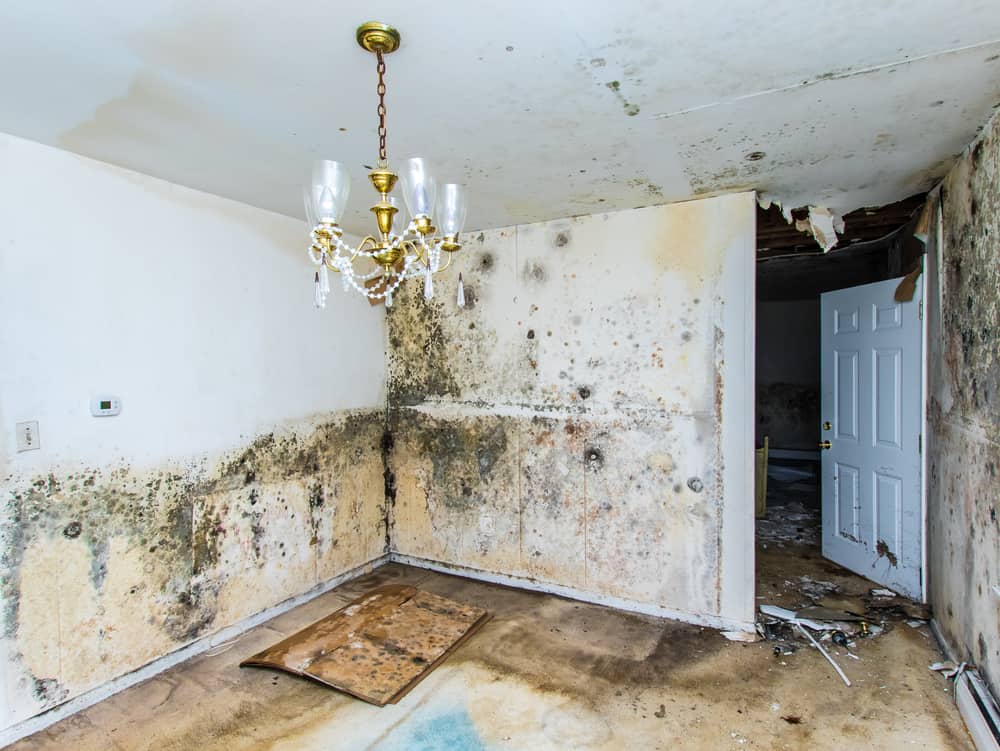
Mold remediation, if needed, adds $10 to $25 per square foot for standard jobs, or $15 to $30 per square foot if the mold is in hard-to-reach areas like wall cavities or HVAC systems. Black mold or toxic varieties can add another 25% to 50% to the cost because of safety protocols and specialized equipment.
Here’s what that looks like in real numbers. A 200-square-foot living room with Category 1 water damage might cost $600 to $1,500 for mitigation and drying. If the drywall and carpet need replacing, add another $4,000 to $7,400 for reconstruction. Total: $4,600 to $8,900.
Same room, but with Category 3 water from a sewage backup. Mitigation jumps to $1,400 to $1,500. Everything the water touched gets removed and disposed of as hazardous waste, so reconstruction costs climb. You’re easily looking at $8,000 to $12,000 or more.
Location matters too. Work in Nassau County can run higher than the national average because of the cost of living, labor rates, and the need for specialized equipment to handle coastal humidity and storm-related damage.
The best way to avoid surprises is to ask for a detailed estimate that breaks down square footage, labor, materials, and equipment rental separately. If a company won’t explain their per-square-foot rate or lumps everything into one number, keep looking.
Getting a Fair Water Damage Repair Estimate in Nassau County
Water damage repair pricing in 2026 comes down to three things: the type of water, how much damage it caused, and how fast you act. Clean water caught early costs a fraction of what black water or mold-infested damage will run you.
The numbers matter, but so does transparency. We walk you through the estimate, explain the difference between mitigation and reconstruction, and show you exactly what you’re paying for. We don’t pressure you into signing over your insurance claim or hit you with surprise charges halfway through the job.
If you’re dealing with water damage in Nassau County, get a detailed estimate before any work starts. Ask about water category, damage class, and per-square-foot rates. Make sure we’re using moisture meters and infrared imaging to find hidden damage, not just guessing based on what’s visible.
When the work is done right, you’re not just getting your home dryyou’re protecting it from mold, structural damage, and the kind of problems that resurface months later. That’s worth paying for. We’ve been helping Long Island homeowners navigate these situations for over 35 years, with transparent pricing and direct insurance billing that takes the pressure off when you need it most.
Article details:
- Published by:
- First Response Restoration
- Published to:
- Last modified:
- July 27, 2026
Share:
Continue learning: