Professional vs DIY Basement Flood Cleanup Costs
Thinking about handling a flooded basement yourself? Here's what that decision actually costs — and what most Nassau County homeowners don't find out until it's too late.
Share:
Summary:
Your basement has water in it. Maybe it happened overnight, maybe you came home to it, maybe a sump pump gave out during a storm. Whatever the cause, the first instinct for a lot of Nassau County homeowners is to start mopping and hope for the best.
That instinct makes sense. Nobody wants to spend money they weren’t planning to spend. But the gap between what DIY cleanup costs upfront and what it ends up costing later is where most people get burned. This page walks you through the real numbers, the real risks, and what professional flood cleanup actually includes — so you can make the right call with a clear head.
What Flood Cleanup Services Actually Include (And What DIY Leaves Out)
When most people think about cleaning up a flooded basement, they picture removing the standing water and drying things out. That’s part of it — but it’s only the first step. Our flood cleanup services cover the full picture: water extraction, structural drying, moisture mapping, antimicrobial treatment, removal of damaged materials, and a final verification that the space is actually dry before the job is closed.
DIY cleanup typically stops at the visible water. You rent a wet vac for around $150 a day, run some box fans, maybe pick up a consumer dehumidifier. The space looks and feels drier after a few days. The problem is that moisture doesn’t stay where you can see it. It moves into drywall, under flooring, inside wall cavities, and behind insulation — and none of that shows up when you’re walking around with a flashlight.
Why Hidden Moisture Is the Real Risk in DIY Basement Cleanup
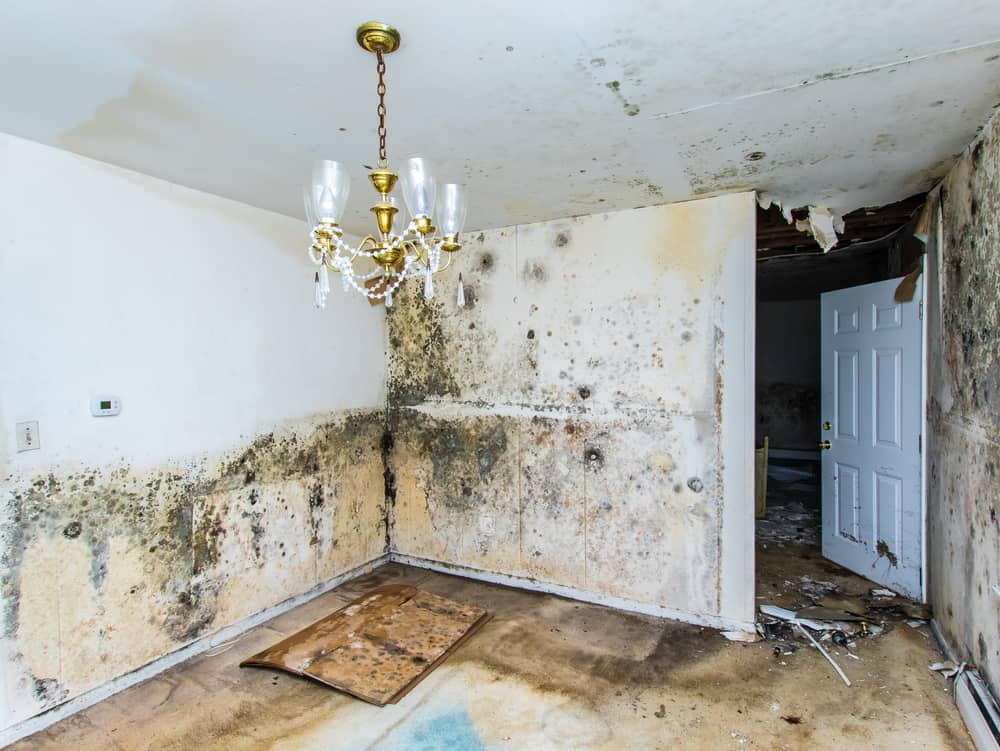
Mold can begin growing within 24 to 48 hours of water exposure. That’s a documented reality that shapes how every legitimate restoration professional approaches a water damage job. The challenge is that by the time mold is visible, it’s already been growing for a while, often in places you’d never think to look.
This is where the equipment gap between DIY and professional really shows up. We use thermal imaging cameras — infrared technology that reads temperature differentials in walls and floors — to locate moisture that has no visible trace. A wall can look completely fine and register dangerously high moisture levels on a thermal scan. Without that scan, you’re guessing. And with water damage, guessing tends to be expensive.
Nassau County’s housing stock makes this especially relevant. A huge portion of the county’s homes were built between the late 1940s and early 1970s — Cape Cods, split-levels, and ranch homes that are now 70-plus years old. These houses have older framing, original insulation in many cases, and finished basements that have been renovated over the decades. Water gets into those layers and stays there. A consumer dehumidifier running for three days isn’t going to pull moisture out of mid-century framing behind finished drywall.
The other factor worth understanding is water contamination category. Not all basement flooding involves clean water. A backed-up drain, a sewage line issue, or floodwater coming in from outside qualifies as Category 2 or Category 3 contamination — gray water or black water — and those situations require professional-grade protective equipment and disposal protocols that simply aren’t part of a DIY cleanup. Attempting to clean up contaminated water without the right approach doesn’t just risk missing moisture; it risks real health exposure for you and your family.
How Long Does Professional Basement Flood Cleanup Take Compared to DIY?
The honest answer for professional cleanup is four to six days for complete structural drying, depending on the size of the space, the extent of the damage, and how quickly work started after the flooding occurred. That timeline covers extraction, drying with industrial-grade equipment, and a final moisture check before anything is closed up. It’s not a fast process — because drying done right isn’t fast.
DIY timelines vary wildly, and that’s part of the problem. A consumer dehumidifier might run for a week and still leave moisture in the walls because it doesn’t have the capacity to pull water out of structural materials the way a low-grain refrigerant (LGR) industrial unit does. Our equipment isn’t just bigger — it operates differently, pulling moisture from the air and surfaces at a rate that consumer units can’t match.
There’s also the time investment on your end to consider. Managing a DIY cleanup — renting equipment, monitoring drying progress, making trips to the hardware store, disposing of damaged materials — takes real hours out of your week. For Nassau County homeowners with finished basements, that often means tearing out wet drywall and flooring yourself, hauling debris, and then figuring out what to do with a half-demolished basement that still may not be fully dry. Our crews handle all of that as part of the job. You don’t manage the process — you hand it off and get updates.
The time comparison matters most when you factor in the mold window. Every day of delay in getting proper drying equipment running is a day closer to a mold problem. A DIY approach that takes a week to fully execute — even if executed well — has already lost significant ground compared to our crews that arrive within an hour and have industrial equipment running the same day.
Flood Restoration Services vs. Cleanup: Understanding What Full Recovery Looks Like
There’s an important distinction between cleaning up after a flood and actually restoring a basement to the condition it was in before the water arrived. Cleanup gets the water out. Restoration handles everything that comes after — damaged drywall, ruined flooring, compromised insulation, mold prevention, and getting the space back to livable condition.
Most homeowners who attempt DIY cleanup are really only attempting the first part. The restoration side — demolition of unsalvageable materials, rebuilding, mold testing, reconstruction — is where the real cost and complexity lives. Our flood restoration services that cover the full scope from extraction through rebuild are a different proposition than renting a wet vac and hoping for the best.
Water Damage Restoration Cost: What Drives the Numbers in Nassau County
The range for professional basement flood cleanup is wide because the variables are significant. For water extraction and drying alone — no demolition, no reconstruction — Nassau County homeowners are typically looking at $2,500 to $6,500. For a finished basement that requires removing wet drywall, flooring, and insulation before rebuilding, the range climbs to $8,000 to $22,000 depending on the size of the space and the extent of the damage.
DIY cleanup, by comparison, runs $500 to $2,500 for minor flooding — primarily equipment rental and disposal. That’s a real cost difference on paper. But the DIY number assumes everything goes right: no hidden moisture, no mold, no contamination, no structural material that needs professional removal. In practice, Nassau County’s finished basements — many of them home offices, rec rooms, and family spaces that have been built out over decades — don’t leave much room for incomplete cleanup. When DIY misses hidden moisture and mold develops three weeks later, the remediation and reconstruction cost reaches that $8,000 to $22,000 range, except now you’ve already spent $1,500 on a cleanup that didn’t work.
The insurance piece changes the math significantly. Most homeowners insurance policies cover sudden and accidental water damage from internal sources — burst pipes, appliance failures, sump pump overflow with the right rider. They do not typically cover flooding from external sources, which requires separate flood insurance. If your damage is covered, professional restoration doesn’t have to mean a large out-of-pocket cost. We bill insurance directly and maintain communication with your carrier throughout the process, so you’re not navigating a claims conversation while your basement is still wet. We also cover up to $500 of your insurance deductible — which means for many covered jobs, the financial gap between DIY and professional is smaller than it looks.
Nassau County Basement Flooding: Why Local Conditions Make Professional Response Worth It
Nassau County has a specific flooding profile that matters when you’re weighing cleanup options. Much of the county sits over a substrate with high groundwater tables — in many areas, the water table during a heavy rain event is only a few feet below the basement floor. The storm drainage infrastructure in communities across Nassau County was built for mid-20th century population density and is routinely overwhelmed by the kind of rain events Long Island sees regularly. Add in the age of the housing stock and the prevalence of finished basements, and you have a market where basement flooding isn’t a rare event — it’s a recurring reality.
Hurricane Sandy in 2012 was a turning point for a lot of South Shore communities — Long Beach, Freeport, Oceanside, Valley Stream — where flooding reached levels that permanently changed how homeowners think about their basements. The remnants of Hurricane Ida in 2021 caused flooding in interior Nassau County neighborhoods that had never seen it before. These weren’t freak events in hindsight; they were previews of what Long Island’s storm exposure actually looks like.
We’ve been operating in Nassau County since 1991, which means we’ve worked through Sandy, Ida, and every nor’easter and pipe-burst winter in between. Our technicians are all IICRC-certified — not just our supervisors, but every person who walks into your home — and we carry the infrared imaging equipment needed to find moisture in the walls of a 1960s split-level in Mineola or a finished basement in Massapequa. We respond within 30 to 60 minutes, 24 hours a day, every day of the year, because sump pumps don’t fail on schedule and storms don’t wait for business hours.
For Nassau County homeowners specifically, the argument for professional cleanup isn’t just about doing a better job. It’s about understanding that the local conditions — the groundwater, the housing stock, the storm history — make incomplete cleanup genuinely costly in ways that don’t show up until months later.
Making the Right Call on Basement Flood Cleanup in Nassau County
The honest bottom line: for very minor flooding with clean water, limited affected area, and no finished materials involved, a careful DIY approach can work. But that scenario describes a small fraction of the basement flooding calls we see in Nassau County. Most involve finished spaces, older homes, contaminated water, or damage that went undetected long enough to complicate things.
Professional cleanup costs more upfront. But when insurance is in the picture, when hidden moisture is a factor, and when the alternative is a mold problem three weeks from now, the math tends to favor getting it done right the first time. The cost of a failed DIY cleanup isn’t just the money you spent — it’s the money you’ll spend on top of it.
If you’re dealing with a flooded basement right now or trying to figure out your options after a recent event, First Response Restoration and Cleaning Inc. is available around the clock. One call gets you a real answer about what you’re dealing with and what it’s going to take to fix it.
Article details:
- Published by:
- First Response Restoration
- Published to:
- Last modified:
- October 13, 2026
Share:
Continue learning: